

Brand Monitoring: The Complete Guide (2026)
What brand monitoring is, what to track, how to set up alerts and how to measure share of voice. A practical guide for marketing and PR teams.
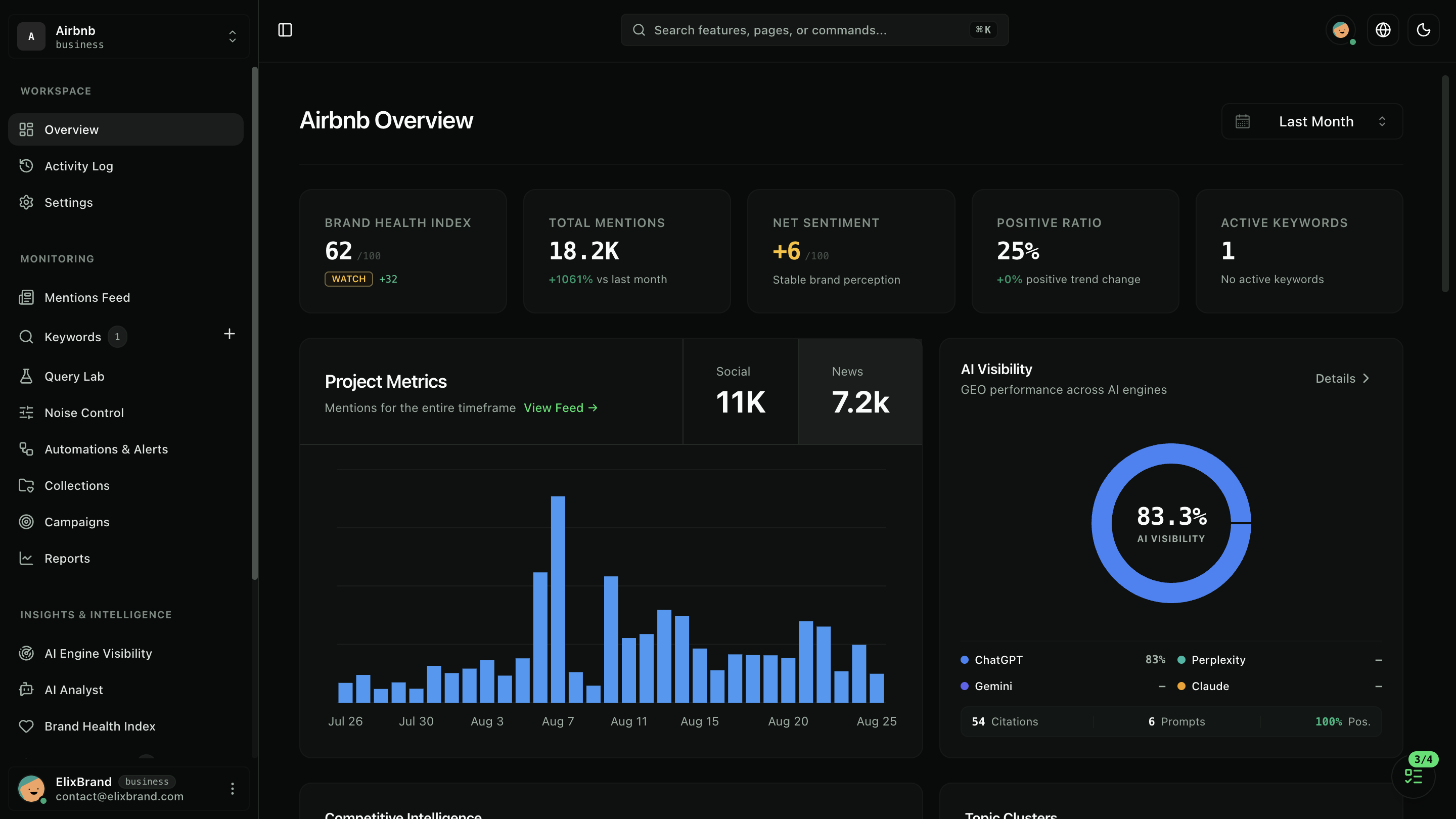
Your brand is defined by what buyers, journalists, creators, and AI assistants say about you when you are not in the room. In 2026, that conversation unfolds across dozens of disconnected surfaces at once: regional and national news outlets, Reddit threads, YouTube comment sections, Substack newsletters, G2 and Trustpilot review pages, podcast transcripts, and conversational AI answers on ChatGPT, Google Gemini, Perplexity, and Claude.
If a customer publishes a detailed critique of your onboarding on a niche subreddit at 9:00 AM, it can be quoted in a developer newsletter by noon, indexed by search engines by mid-afternoon, and repeated as fact by an AI assistant when a prospective buyer asks for product recommendations the next morning.
This guide combines our foundational getting-started framework and our complete 2026 brand monitoring handbook into one practical reference for marketing, PR, and communications teams. You will learn what brand monitoring is, how it differs from social media management and social listening, which keyword categories to track, how to configure noise-free Boolean queries and real-time alert rules, and how to measure share of voice and business impact.
1. What Is Brand Monitoring?
Brand monitoring is the continuous process of tracking public mentions of your organization, products, executives, campaigns, and competitors across news media, blogs, social networks, discussion forums, review portals, podcasts, newsletters, and AI search engines.
The goal of brand monitoring is twofold:
- Operational awareness in real time: Catching customer complaints, technical outages, misinformation, press pickups, and viral discussions within minutes of publication so your team can respond while the conversation is still active.
- Longitudinal brand intelligence: Measuring how your mention volume, sentiment polarity, reach, share of voice (SOV), and AI Share of Model change week over week and quarter over quarter.
How Brand Monitoring Differs from Social Media Notifications and Social Listening
Marketing teams frequently use social media monitoring, brand monitoring, and social listening interchangeably, yet each solves a distinct problem:
| Discipline | Primary Scope | Core Question It Answers | Typical Action Taken |
|---|---|---|---|
| Native Social Notifications | Only posts that explicitly @tag your owned social handles on X, Instagram, LinkedIn, or Facebook | "Who tagged our official handle today?" | Community manager replies to a direct tag |
| Brand Monitoring | Untagged and tagged mentions of your brand, products, and executives across news, blogs, forums, reviews, social media, podcasts, and AI answers | "Where is our brand being discussed right now, and is the coverage positive, neutral, or negative?" | PR intervention, support escalation, journalist outreach, crisis containment |
| Social Listening | Broader category, problem, and competitor conversations—even when your brand name is never mentioned | "What do buyers in our market care about, complain about, or ask for?" | Content strategy, product roadmap decisions, competitive positioning |
Most high-impact mentions never tag your official account. A journalist writing a feature story in an industry publication, a founder comparing three vendors in a Reddit thread, or a YouTuber reviewing your latest release will write your brand name in plain text without an @ handle. Native social media inbox tools miss 100% of those conversations. Dedicated brand mention monitoring captures them all in one unified feed.
2. Why Brand Monitoring Matters in 2026
Four structural shifts have changed how brand reputation works online:
A. Community Forums and Reviews Drive B2B and Consumer Buying Decisions
Buyers rarely trust vendor landing pages alone. Before starting a trial or booking a sales demo, they search "YourBrand vs Competitor", "YourBrand reddit", or "is YourBrand worth it". A single unanswered negative thread on Reddit, Quora, or Trustpilot can quietly depress conversion rates for months if your team does not know it exists.
B. AI Assistants Synthesize Public Web Mentions into Buyer Recommendations
When a buyer asks ChatGPT, Google Gemini, Perplexity, or Claude "What is the best tool for [your category]?", the model does not guess at random. It retrieves and synthesizes editorial articles, comparison blogs, forum discussions, and review sites. If your competitors are cited on those third-party pages and your brand is absent—or framed negatively—AI assistants will recommend your competitors instead. Tracking your AI search visibility alongside traditional media monitoring is now essential.
C. Digital Crises Escalate in Under an Hour
PR crises follow a predictable four-stage contagion curve:
- The Spark: A single customer complaint, pricing backlash, or service error is posted on a social platform or forum.
- The Kindling: Niche communities (Reddit, X circles, Discord servers, Hacker News) amplify the post and add commentary.
- The Fire: Industry newsletters, creators, and trade blogs publish articles about the controversy.
- The Inferno: Mainstream news outlets cover the story, cementing it in search results.
Teams that detect a negative spike at Stage 1 or Stage 2 can resolve the underlying issue and post a transparent update within the first 60 minutes—before trade press or mainstream journalists ever pick it up.
D. Earned Media and Creator Mentions Have a Short Engagement Window
When a journalist, newsletter author, or YouTube creator mentions your brand positively, engaging within the first few hours—thanking them, sharing the piece, or offering exclusive data for a follow-up—builds lasting media relationships. Finding out about an article three weeks later wastes the opportunity.
3. What to Track: The Five Essential Keyword Pillars
A common mistake when setting up brand monitoring is tracking only your exact company name. To get complete visibility without drowning in irrelevant noise, organize your tracked terms into five keyword pillars:
Pillar 1: Core Brand & Spelling Variations
Track your official brand name, common misspellings, spacing variations, and domain names:
- Official name and spacing variants (e.g.,
ElixBrand,Elix Brand) - Primary web domains (
elixbrand.com) - Common phonetic typos or autocomplete errors
- Branded hashtags (
#elixbrand)
Pillar 2: Products, Features & Sub-Brands
Customers often complain about or praise a specific product line or signature feature without naming the parent company:
- Product and tier names
- Signature modules (for example,
Report StudioorCrisis Radar) - Integration or API names
Pillar 3: Key Executives & Spokespeople
In B2B, finance, and technology, a founder's or CEO's reputation is inseparable from the company's reputation:
- CEO, founders, and public spokespeople
- Key subject-matter experts who appear on podcasts or panels
- Keynote or conference talk titles
Pillar 4: Direct Competitors & Alternative Intent
Tracking competitors turns your monitoring platform into a continuous competitive intelligence engine:
- Direct competitor brand names and product names
- High-intent switching queries:
"CompetitorName alternative","CompetitorName pricing","switching from CompetitorName","CompetitorName down" - Category comparisons:
"YourBrand vs CompetitorName"
Pillar 5: Industry Pain Points & Category Keywords
Used primarily for social listening and demand generation:
- Problem statements your product solves (e.g.,
"how to track brand mentions","client reporting tool for PR agency") - Regulatory or industry trend terms that affect your buyers
4. How to Build Clean Boolean Queries (and Eliminate Noise)
If your brand name is a common dictionary word (such as Mention, Front, Linear, or Apple), a naive keyword search will flood your feed with thousands of unrelated posts. Precision query construction solves this problem.
Step 1: Combine Synonyms with OR
Group all variations of a concept inside parentheses using OR:
("ElixBrand" OR "Elix Brand" OR "elixbrand.com")
Step 2: Anchor Ambiguous Names with AND Context Terms
If your brand name shares a word with an everyday noun, require at least one industry context term:
("Acme" AND ("software" OR "platform" OR "API" OR "pricing" OR "dashboard" OR "app"))
Step 3: Exclude Known False Positives with NOT
Inspect your first 48 hours of mentions, identify recurring irrelevant topics (such as job board scrapers, stock ticker bots, or unrelated companies in other industries), and exclude them:
("Acme" AND ("software" OR "cloud")) NOT ("Acme Supermarket" OR "Acme Brick" OR "hiring" OR "job opening")
Step 4: Separate High-Intent Buyer Queries from General Mentions
Create a dedicated saved filter or collection for commercial-intent mentions where someone is actively asking for a recommendation or complaining about a rival:
("CompetitorA" OR "CompetitorB") AND ("alternative" OR "expensive" OR "broken" OR "cancel" OR "switching" OR "recommend")
5. Which Channels and Sources Should You Monitor?
A complete brand monitoring setup covers seven distinct media layers. You can inspect the full list of supported platforms on our Sources We Monitor page:
- News Outlets & Digital Press: Global, national, and trade publications, wire services, and regional newspapers. Crucial for news monitoring and PR coverage tracking.
- Blogs & Editorial Publications: WordPress publications, Medium articles, and independent industry blogs that rank in organic search and feed AI training citations.
- Discussion Forums: Reddit subreddits, Quora questions, and technical community forums where buyers speak candidly without marketing polish.
- Review Sites: G2, Trustpilot, Capterra, and consumer review platforms where a 1-star or 5-star review directly impacts buyer trust.
- Social Media & Video Platforms: YouTube videos and comment threads, X (Twitter), LinkedIn, Facebook, Instagram, Meta Threads, TikTok, Bluesky, and Mastodon.
- Podcasts & Email Newsletters: Substack publications, creator newsletters, and transcribed podcast episodes where industry leaders shape B2B narratives.
- AI Search Engines: Auditing ChatGPT, Google Gemini, Perplexity, and Claude to verify whether AI assistants recommend your brand when buyers ask category questions.
6. Setting Up Real-Time Alerts Without Alert Fatigue
Staring at a dashboard all day is neither practical nor scalable. On the other hand, sending an email notification for every single neutral mention will cause your team to mute the alerts within a week.
Use a three-tier alerting architecture routed to the channels your team already uses (Email, Slack, Telegram, Discord, or custom webhooks):
Tier 1: Immediate Crisis & Escalation Alerts (Real-Time Slack / Telegram / Webhook)
Trigger an instant notification when:
- Negative Sentiment Spike: Negative mentions exceed 20% of total volume within a 2-hour window, or a single negative mention comes from a high-reach source.
- Volume Anomaly: Mention volume jumps by more than 200% compared to your 7-day rolling baseline.
- Risk Keywords: Any mention combines your brand name with high-risk terms such as
"outage","down","breach","lawsuit","scam","bug", or"data leak".
Tier 2: High-Opportunity Alerts (Hourly or Real-Time to PR & Marketing Channels)
Trigger notifications to your PR or growth channel when:
- A verified journalist, high-authority news domain, or creator with significant reach mentions your brand.
- A forum post matches your competitor-switching query (
"alternative to [Competitor]").
Tier 3: Executive & Stakeholder Digests (Scheduled Daily or Weekly Email Reports)
Instead of raw alerts, leadership and clients need synthesized trends. Use Report Studio to schedule automated weekly or monthly PDF, CSV, or Excel reports summarizing total mentions, net sentiment shifts, top news pickups, and competitor share of voice.
7. Key Brand Monitoring Metrics & How to Measure Share of Voice
To turn raw mentions into decisions that executives and clients respect, track five core metrics consistently:
1. Mention Volume & Velocity
The total number of times your brand or keyword was mentioned during a period, plus the rate of change (velocity). Volume spikes tell you when an event occurred; pairing volume with topic clustering tells you why.
2. Net Sentiment Score & Emotion Breakdown
Using AI sentiment analysis, every mention is classified as Positive (including strongly positive), Neutral, or Negative (including strongly negative), along with underlying emotions (Joy, Anger, Fear, Sadness, Surprise).
Calculate your Net Sentiment Score on a scale from -100 to +100:
Net Sentiment = ((Positive Mentions - Negative Mentions) / Total Mentions) × 100
Tracking Net Sentiment over time reveals whether product releases, pricing changes, or PR campaigns are improving or eroding public perception.
3. Estimated Reach & Exposure
A mention in a major national news outlet or a YouTube channel with 500,000 subscribers carries vastly more weight than a post from an account with 10 followers. Summing estimated reach across your mentions helps quantify total audience exposure.
4. Share of Voice (SOV)
Share of Voice measures your brand's visibility relative to your direct competitors across earned media and social conversations:
Share of Voice (%) = (Your Brand Mentions / Total Mentions of Your Brand + All Tracked Competitors) × 100
You can compute SOV by mention count (conversation share) and by reach (impression share). If your mention SOV is 20% but your reach SOV is 38%, your brand is winning coverage in larger, more authoritative publications than your competitors.
5. Share of Model (AI Search Visibility)
In 2026, traditional Share of Voice must be paired with Share of Model: the percentage of buyer-intent prompts on ChatGPT, Google Gemini, Perplexity, and Claude in which the AI assistant recommends or cites your brand compared to competitors.
8. Step-by-Step: Getting Started with ElixBrand in 15 Minutes
Here is the exact checklist to launch your brand monitoring workflow in ElixBrand today:
- Create Your Project Workspace: Start your 7-day free trial and create a project for your brand (or one workspace per client if you run an agency).
- Add Your Core Keywords: Enter your primary brand name, product names, and 2–3 direct competitor names. Start with 3 keywords on the Individual plan ($29/month), 15 on Pro ($99/month), or 50 on Business ($299/month).
- Verify Your First Live Mentions: ElixBrand immediately scans news outlets, blogs, forums, social platforms, and video channels, populating your unified feed with sentiment tags and reach metrics.
- Fine-Tune Noise Rules in Query Lab: If your brand name has homonyms, add excluded keywords or domain filters so your dashboard stays 100% relevant.
- Connect Your Alert Channels: Link your Slack workspace, Telegram group, Discord server, or email list and create two rules: one for negative sentiment spikes and one for high-reach press mentions.
- Run an AI Search Visibility Audit: Open the AI Search Visibility module, run buyer-intent prompts in your category, and inspect which third-party articles ChatGPT and Gemini cite when recommending vendors.
- Schedule Your First Stakeholder Report: Open Report Studio, pick the Executive Summary or PR Coverage template, add your logo, and schedule a weekly Monday morning PDF delivery.
Frequently Asked Questions About Brand Monitoring
How much does a brand monitoring tool cost?
Professional brand monitoring no longer requires a $15,000/year enterprise contract. At ElixBrand, self-serve plans start at $29/month for Individual (news and web monitoring, 5,000 mentions, 3 keywords), $99/month for Pro (adds forums, review sites, advanced emotion analysis, and 25 monthly AI visibility audits), and $299/month for Business (adds social media, podcasts, newsletters, 100,000 mentions, Crisis Radar, and webhooks). Every plan includes a 7-day free trial. Compare all tiers on our pricing page.
Can I monitor my competitors with the same tool?
Yes. You can allocate any of your tracked keyword slots to competitor brand names, product names, or executive names. Read our Competitor Analysis Guide for step-by-step Boolean templates.
What is the best way to organize media relationships from brand mentions?
When you discover journalists, bloggers, or YouTube creators who repeatedly cover your space, log them directly in your relationship tracker. See our complete Media Relationships Guide for PR Teams to see how PR teams turn raw mentions into long-term press partnerships.
Monitor every news article, social mention, and AI citation in one place
Start tracking your brand across global press, Reddit, podcasts, newsletters, and ChatGPT/Gemini/Perplexity answers. Transparent monthly pricing from $29/mo.
Continue reading
All articlesSocial listening: the complete guide
What social listening is, how it differs from monitoring, which metrics to track and how to start. A practical guide with examples.
Crisis Management with Social Listening
A PR crisis can strike at any moment. Learn how real-time monitoring serves as your early warning system to prevent total reputation collapse.
Competitor Analysis: A Legal, Practical Guide
Competitor analysis is the secret weapon of growth hackers. Learn how to use brand monitoring to steal strategies, identify gaps, and win market share.