

Social listening: the complete guide
What social listening is, how it differs from monitoring, which metrics to track and how to start. A practical guide with examples.
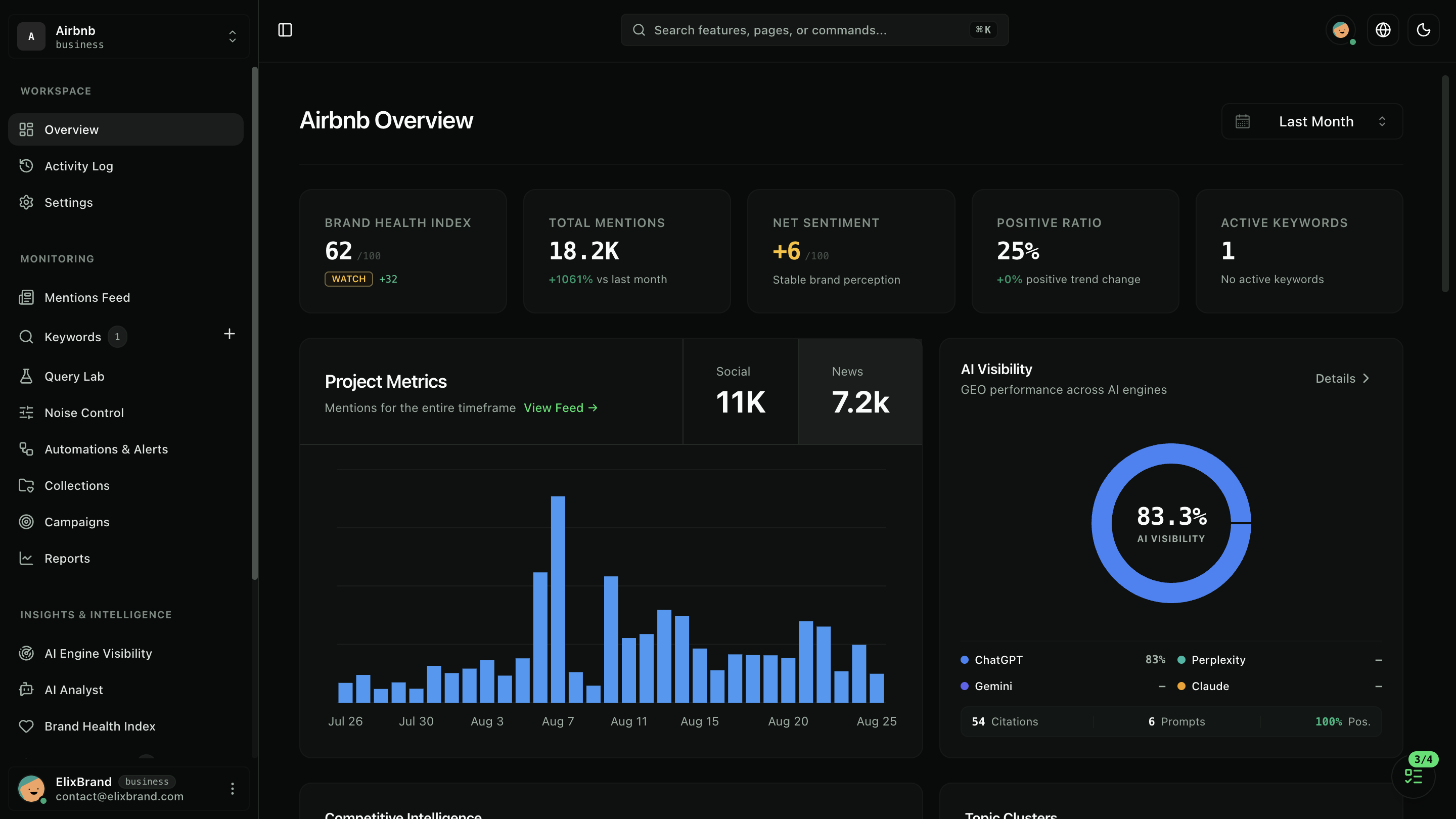
Every day, thousands of buyers discuss the exact problem your product solves. They ask for tool recommendations on Reddit, compare vendors in YouTube comment threads, complain about your competitors' pricing on X and LinkedIn, write candid reviews on G2 and Trustpilot, and ask ChatGPT or Google Gemini which brand they should trust.
Most of those conversations never tag your official social media handle. If your team only watches your native @mentions inbox, you are missing 90% of the market conversation.
Social listening is how modern marketing, PR, product, and agency teams capture and analyze those conversations—turning unstructured public chatter into product improvements, early crisis containment, competitive wins, and organic pipeline.
In this complete guide, we cover what social listening is, how it differs from social media monitoring, which metrics matter, five real-world workflows with examples, and how to launch your social listening program step by step.
1. What Is Social Listening?
Social listening is the continuous process of collecting public conversations about your brand, your competitors, your executives, and your broader industry category across social networks, discussion forums, blogs, news outlets, podcasts, newsletters, and review sites—and analyzing that data to uncover sentiment shifts, buyer pain points, and market trends.
A complete social listening tool works in two stages:
- Collection (Wide-Net Ingestion): Indexing public mentions across Reddit, YouTube, X (Twitter), LinkedIn, Facebook, Instagram, Threads, TikTok, Bluesky, Mastodon, Quora, review sites, blogs, newsletters, podcasts, and news outlets—including untagged plain-text mentions.
- Intelligence & Action (AI Enrichment): Scoring every mention for sentiment polarity and emotion, clustering recurring topics, benchmarking competitive Share of Voice (SOV), and routing high-priority alerts to Slack, Telegram, Discord, or email.
2. Social Listening vs. Social Media Monitoring: What Is the Difference?
One of the most common questions in marketing is how social listening differs from social media monitoring. While the two complement each other, they operate at different altitudes:
| Dimension | Social Media Monitoring | Social Listening |
|---|---|---|
| Core Perspective | Micro / Reactive: Looks at individual posts and direct tags | Macro + Micro / Proactive: Looks at untagged brand mentions, competitors, industry topics, and aggregate sentiment trends |
| What It Tracks | Direct @mentions, comments on your owned posts, and branded hashtags | Untagged brand names, product names, competitor complaints, category pain points, press articles, forums, and AI search citations |
| Primary Goal | Reply to individual users and manage daily community engagement | Understand why perception is shifting, catch crises early, discover product gaps, and win customers switching from competitors |
| Typical Metrics | Reply time, likes, shares, comment count | Net Sentiment Score, Share of Voice (SOV), emotion distribution, topic velocity, and AI Share of Model |
Think of it this way: social media monitoring looks at the trees; social listening maps the entire forest—and still lets you zoom in on any individual tree that catches fire.
3. Five Practical Ways Teams Use Social Listening (With Examples)
Social listening delivers the highest return when every department has a concrete workflow tied to it. Here are five proven use cases:
1. Catching High-Intent Buyers & Competitor Churn
Buyers frequently go to Reddit, Quora, LinkedIn, or X to ask peers for advice before buying:
- "We're frustrated with CompetitorA's latest price hike—what's a better alternative for a 10-person agency?"
- "Can anyone recommend a tool that tracks both news articles and Reddit threads?"
By setting up a Boolean listening stream for competitor names paired with switching keywords ("alternative", "too expensive", "cancel", "switching", "recommend"), your growth team gets an instant Slack alert and can join the conversation while the buyer is actively evaluating options.
2. Unfiltered Product Feedback & Roadmap Discovery
Support tickets only tell you what broke for existing customers who bothered to email support. Social listening shows you what prospective buyers and churned users say when they think you aren't listening.
Filtering your mentions—and your competitors' mentions—by Negative sentiment + Sadness or Anger reveals which missing features, UX friction points, or pricing rules cost you deals.
3. Early-Warning Crisis Management
Before a controversy ever becomes a headline in trade press, it starts as a cluster of negative posts on Reddit, X, or review portals. Configuring automated negative sentiment velocity alerts lets your communications team trace "Patient Zero" and respond within the first 60 minutes. Read our full guide on Crisis Management with Social Listening for the complete incident playbook.
4. Discovering Creators, Journalists & Advocates
Who are the most influential voices already talking about your category? Social listening surfaces the exact YouTube creators, Substack authors, Reddit contributors, and industry journalists who discuss your topic—ranked by audience reach and sentiment. PR teams use our Media Relationships workflow to turn those organic mentions into long-term press and creator partnerships.
5. Shaping AI Search Visibility (GEO)
In 2026, social listening is directly tied to Generative Engine Optimization (GEO). Conversational AI engines like ChatGPT, Google Gemini, Perplexity, and Claude frequently cite Reddit threads, Medium blogs, G2 reviews, and editorial roundups when recommending software and consumer brands. Listening to—and participating in—those exact community threads improves how AI assistants describe and recommend your brand.
4. Which Social Listening Metrics Should You Track?
Avoid vanity metrics like raw potential impressions alone. Focus your weekly and monthly reporting on five decision-ready metrics:
- Mention Volume & Velocity: Total mentions over time and percentage change versus the prior period. Velocity spikes pinpoint the exact hour a campaign, press pickup, or controversy took off.
- Net Sentiment Score (-100 to +100): Calculated as
((Positive Mentions - Negative Mentions) / Total Mentions) × 100. Always segment Net Sentiment by platform (for example, Reddit vs. LinkedIn vs. News) so channel norms don't skew your baseline. See Sentiment Analysis Explained. - Emotion Breakdown: The share of conversation driven by Joy, Anger, Fear, Sadness, and Surprise—crucial for prioritizing whether a spike needs customer support, security reassurance, or marketing amplification.
- Competitive Share of Voice (SOV): Your brand's share of total category mentions and estimated reach compared to your top 3–5 competitors.
- AI Share of Model: The percentage of buyer-intent prompts on ChatGPT, Google Gemini, and Claude where your brand is recommended compared to competitors (measured via ElixBrand AI Search Visibility).
For a complete breakdown of how to report these numbers to leadership, see our guide on 12 Social Media Metrics to Track in 2026.
5. How to Start Social Listening in 4 Steps
You do not need months of setup or a data science team to launch a high-impact social listening program:
Step 1: Set Up Three Keyword Streams
Start with three focused streams rather than fifty noisy ones:
- Stream A (Your Brand & Products): Your brand name, common misspellings, domain, product names, and key executives.
- Stream B (Direct Competitors): Your top 3 competitors, plus a saved filter for switching-intent terms (
"alternative","pricing","vs"). - Stream C (Category Problem Keywords): 2–3 core phrases buyers use when asking for help in your space.
Step 2: Refine Boolean Rules to Remove Noise
Use AND, OR, and NOT operators to exclude homonyms, job postings, or unrelated industries so every mention in your feed is relevant.
Step 3: Route Alerts by Intent
- Send Negative sentiment spikes & high-reach critical mentions to your
#comms-alertsor#support-triageSlack/Telegram channel in real time. - Send Competitor switching & recommendation threads to your
#growth-opportunitieschannel.
Step 4: Automate Weekly Stakeholder Reports
Use Report Studio to schedule an automated weekly or monthly PDF and Excel digest summarizing your Share of Voice, Net Sentiment trend, top conversations, and AI Search Visibility.
Choose Your Social Listening Stack
If you are comparing platforms, review our breakdown of the 12 Best Social Listening Tools in 2026, or jump right in and start your 7-day free trial of ElixBrand—with plans starting at $29/month.
Monitor every news article, social mention, and AI citation in one place
Start tracking your brand across global press, Reddit, podcasts, newsletters, and ChatGPT/Gemini/Perplexity answers. Transparent monthly pricing from $29/mo.
Continue reading
All articlesSocial media metrics worth tracking
The social media metrics worth tracking, what each one tells you and how to report them.
Brand Monitoring: The Complete Guide (2026)
What brand monitoring is, what to track, how to set up alerts and how to measure share of voice. A practical guide for marketing and PR teams.
Crisis Management with Social Listening
A PR crisis can strike at any moment. Learn how real-time monitoring serves as your early warning system to prevent total reputation collapse.